
The Paris Marathon route, printed
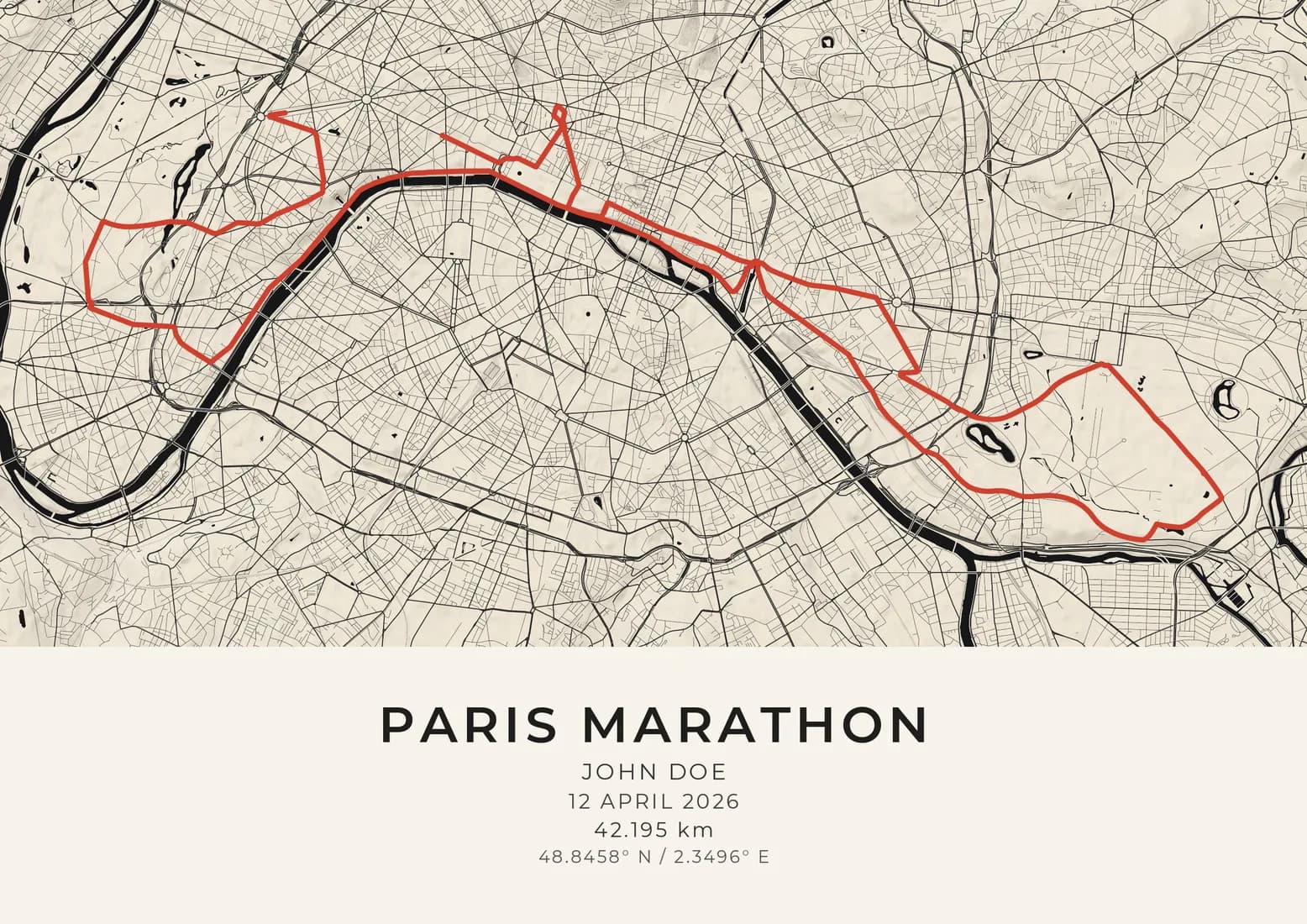
The 2026 course, 42.195 km, from Paris, France.
- Styles
- 19 colourwaysto choose from
- 300 DPIsharp at every size
- Price
- From £24.95delivered free
- Paper
- 240 gsmsmooth fine-art paper
The 2026 course is already drawn on the map, with the distance beneath it. Add your name and your finishing time, choose a style, and preview the finished artwork before you buy. Prices from £24.95, and delivery is free.
Paris sets off on the cobbles of the Champs-Élysées and ends on Avenue Foch, and in between it crosses both of the city's great woods and runs for kilometres beside the Seine.
The opening kilometres run downhill. From the Champs-Élysées the field drops to Place de la Concorde, loops round the Opéra Garnier and follows rue de Rivoli to Bastille, one of the loudest places on the course, at around seven kilometres. Then the road rises gently up rue du Faubourg Saint-Antoine towards Place de la Nation before Avenue Daumesnil leads out to the Bois de Vincennes. On 12 April 2026 almost 59,000 people started, released in waves, and more than 57,000 of them reached the finish.
The Bois de Vincennes is the quiet part of the day. Spectators thin out among the trees, the road rises and falls in short pitches past Lac Daumesnil and the edge of the Château de Vincennes, and two climbs come back to back from about sixteen kilometres. A little after twenty kilometres the course leaves the wood, drops to the river and begins the long run west along the right bank of the Seine. Notre-Dame and later the Eiffel Tower pass across the water, while the riverside road dives through underpasses at the Tuileries and the Pont de l'Alma, each descent paid for with a climb back into daylight.
The hardest work is saved for late. Near the Pont du Garigliano the course leaves the river and climbs for about half a kilometre towards boulevard Exelmans, then enters the Bois de Boulogne beside Roland-Garros, where a long, slightly rising drag lasts several kilometres before the road falls away out of the wood. It is old ground for this race: the first Paris Marathon, in 1976, was run entirely in the Bois de Boulogne. From there the course passes the Trocadéro and finishes on Avenue Foch. In 2026 Shure Demise set a women's course record of 2:18:34, and Yemaneberhan Crippa of Italy won the men's race in 2:05:18.
Questions
Is the Paris course flat?
Not entirely. Both woods bring short climbs, the underpasses along the Seine each end in a rise, and there is a steady pull towards boulevard Exelmans after about 33 kilometres, so the climbing adds up over the distance.
How close are the start and the finish?
Both sit near the Arc de Triomphe: the race sets off on the Champs-Élysées and ends on Avenue Foch, on the other side of the arch, so the course almost closes into a loop.
Can I add my finishing time?
Yes. The title and the line beneath it are yours to write, so your name, your finishing time and your club all fit. The 2026 course and its distance are drawn for you, and you see the finished artwork before you buy.
Is this an official Paris Marathon print?
No. Maps & Son is not affiliated with, or endorsed by, the organisers of the Paris Marathon; the name says which course is mapped. The course is drawn from a route file we use with permission.
Can I change the map?
Yes. The designer opens with the course drawn and the map framed around it. Move the map if you like, choose from 19 styles, and preview the finished artwork before you buy.
How much does a race route print cost?
Prints start at £24.95, printed on 240 gsm smooth fine-art paper, with delivery included to the UK and 25 other countries. Sold as A4, A3, A2 or A1 prints, unframed, at standard sizes so a ready-made frame will fit.
Other courses
Maps & Son is not affiliated with, or endorsed by, the organisers of the Paris Marathon. The course is drawn from a route file we use with permission. For the race itself, see the organisers' website.